Steel, Precast and Signage Crane Hire in Nairobi
Structural steel goes up in a sequence, and the crane is the pace of that sequence. Columns, then rafters, then purlins and bracing, each piece landing where a bolted connection is waiting and a crew is holding it.
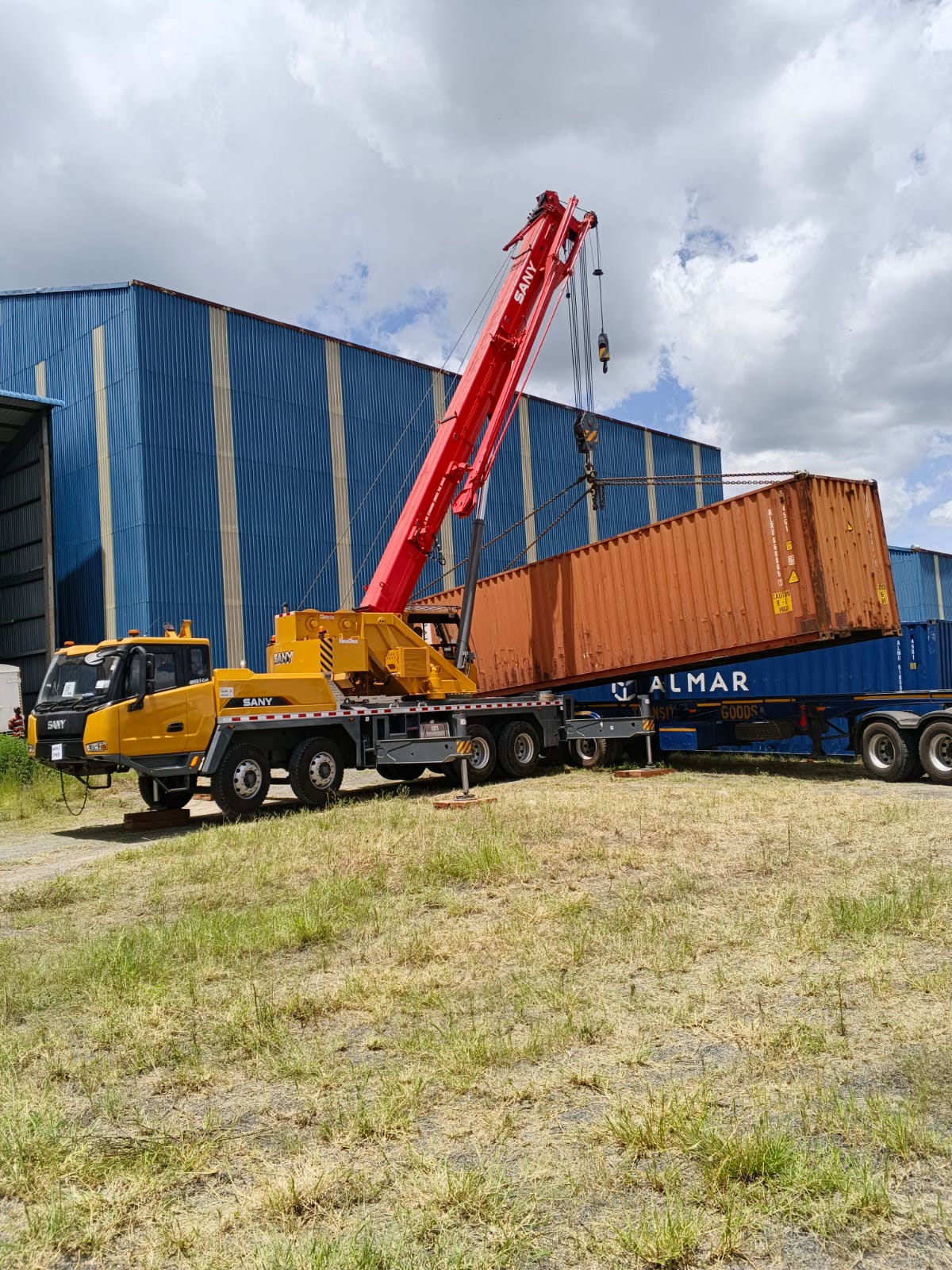
We provide the crane, the operator and the rigging for steel erection on warehouses, factories, mezzanines and commercial frames across Nairobi.
Steel, Precast and Signage Lifting: options, industries and applications
Steel work we support
- Portal frames
- Warehouse and factory frames
- Mezzanine floors
- Roof trusses and purlins
- Structural columns
- Bracing and secondary steel
- Wall and facade panels
- Floor slabs and planks
- Beams and columns
- Culverts and box sections
- Manhole rings and covers
- Stairs and landings
- Roadside billboards
- Building fascia signs
- Gantry and overhead signs
- Illuminated and LED units
- Totem and pylon signs
- Sign removal and replacement
Industries we support
- Construction
- Manufacturing
- Warehousing and logistics
- Commercial development
- Civil engineering
- Infrastructure
- Water and drainage
- Advertising and media
- Retail
- Property and facilities
Typical applications
- Frame erection
- Roof truss installation
- Mezzanine construction
- Steel replacement and strengthening
- Panel erection
- Slab placement
- Culvert installation
- Drainage and manhole units
- New sign installation
- Sign replacement
- Structure erection
- Panel changes at height
The crane sets the programme
On a steel job the crane is rarely idle and never the bottleneck if the sequence is planned. Where jobs slow down is when the erection order was decided without checking what radius the crane can actually work at from each standing position.
We would rather look at the frame drawing before quoting than discover the far corner is out of reach on day two.
Where steel erection crane service fits
Steel Erection Crane Service is not the right answer to every lifting problem, and it is worth being clear about where it fits before you book one.
The sectors that use it most here are construction, manufacturing, warehousing and logistics and commercial development. That is not a marketing list: those are the industries whose problems this machine was designed around, and it shows in how straightforward the jobs tend to be.
In practice the work divides into a handful of recurring tasks: frame erection, roof truss installation, mezzanine construction, steel replacement and strengthening. If your job resembles one of those, this is almost certainly the right machine and the conversation will be short.
If it does not resemble any of them, that is worth saying when you call. It usually means either a different machine or a different approach entirely, and finding that out at the quoting stage costs nothing.
Holding steel while it is fixed
Steel stays on the hook until the connection is made and the member is stable, which means the crane is committed for the duration of each fix rather than the duration of each lift. That is a scheduling fact worth building into your programme.
Rigging matters here too: long members flex and rotate, and need proper slinging and tag lines.
Site access and standing
Steel frames usually go up on a site that is still raw ground. Where the crane cannot get firm standing near the frame, a crawler crane often solves what mats cannot.
Sequence, radius and the far corner
On a steel job the crane is rarely idle, and it is never the bottleneck if the sequence has been planned around what the machine can actually reach from each standing position.
Where jobs slow down is when the erection order was decided from the frame drawing alone. The far corner turns out to be beyond the radius at which the crane can lift that member, and the sequence has to be rebuilt on site with steel already delivered in the wrong order.
We would rather look at the frame drawing and the site layout together before quoting. It takes an hour and it routinely saves days.
Holding steel while it is fixed
Steel stays on the hook until the connection is made and the member is stable. That means the crane is committed for the duration of each fix rather than the duration of each lift, which is a scheduling fact worth building into the programme rather than discovering in week two.
Long members flex and rotate, and need proper slinging and tag lines. See our rigging service, which on steel work is usually hired alongside the crane rather than separately.
Lifting from cast-in anchors
Precast units are designed to be lifted from specific cast-in points using matched lifting clutches. Improvised slinging around a panel is how units crack and how people get hurt.
We check the anchor type and the specified lifting arrangement before the lift, and we will ask the supplier's data sheet if it is not on site.
Panels want to stay vertical
A wall panel lifted flat and rotated to vertical in the air is a controlled manoeuvre, not something to improvise on the hook. Where the design allows, panels are cast and transported to arrive the right way up.
Landing tolerance is the other half: bearings and shims are set before the unit arrives, and the crane holds it while it is aligned and propped.
Civils work
Culverts, box sections and manhole rings are placed into open excavation, which puts the crane on ground next to a trench edge. Standing position and ground assessment matter more here than on almost any other job.
What we need from you to quote
Quoting a steel erection crane service job accurately takes four things, and a photograph usually settles three of them at once. Send them on WhatsApp and you will normally have an answer the same day rather than after a site visit.
What the load is. Roughly what it weighs and what shape it is. A long or awkward item behaves differently from a compact one of the same mass.
Where the machine can stand. A photograph from the likely standing position. We are looking at surface, space, overhead obstructions and how the machine gets in.
How far it has to reach. The distance from the standing position to where the load lands is the number that decides the machine. A short lift close in and a long lift far out are different jobs even when the load is identical.
When you need it. Whether the window is fixed. A lift that must happen inside a shutdown or before a business opens is planned differently from one that can move by a day.
How the hire works
Hire runs by the day unless the job is short enough to price by the half day, and longer bookings are quoted at a weekly or monthly rate that works out considerably cheaper per day than repeat single bookings. If you are running a programme rather than a one-off lift, tell us the duration up front and we will price it that way.
The machine comes with its certified operator. Mobilisation to and from site is quoted separately and depends on distance and access, because a machine that drives itself costs a fraction of one that has to be transported.
We are open 24 hours, Monday to Sunday. Night and weekend work is priced as ordinary hire rather than as a premium emergency callout when it is booked in advance, which is why it pays to plan an out-of-hours lift rather than discover you need one.
Everything is confirmed in writing before the machine is dispatched: the machine, the operator, the window, the standing position and the price.
Safety, certification and what we will not do
Every machine leaves the yard load-tested and maintained on schedule, and every operator carries out a documented pre-use inspection before the first lift of the day. That inspection is not a formality: it is where a damaged sling, a hydraulic weep or a defective limit switch gets found while it is still cheap.
The operator works to the load chart for the configuration actually rigged, at the radius actually being worked. If the chart does not support the lift, the lift does not happen. That is a feature of what you are hiring rather than an obstruction, and it is worth saying plainly at the quoting stage rather than discovering it on the day.
Exclusion zones are maintained under the load throughout, and we will stop if people enter them. On sites where other trades are working through, that coordination is agreed before the first lift rather than negotiated during it.
Where a lift is complex, blind, over occupied space or involves two machines, we agree a lift plan and a signalling arrangement before anything moves, and we will ask for a banksman from your side or provide one from ours.
What goes wrong, and how to avoid it
Almost every job that goes badly does so for one of four reasons, and all four are avoidable at the enquiry stage rather than on the day.
The weight was estimated optimistically. A load described as roughly something turns out to be considerably more, and the machine that travelled cannot lift it. If you genuinely do not know, say so and we will size with margin rather than assume.
The standing position did not exist. The space that looked adequate on a plan is occupied, sloping, or over ground that will not take outrigger loads. A photograph taken from that spot resolves it before anyone travels.
Nobody checked overhead. Power lines, canopies, branches and neighbouring structures constrain the boom path far more often than people expect, and they are not visible in a plan view.
The site was not ready. The crane arrives and waits, because the fixing crew, the propping, the bearings or the access were not in place. Crane time spent waiting is the most expensive time on any site.
None of that is complicated. It is simply worth ten minutes before the booking rather than an hour of standing time afterwards.
Where we do this work in Nairobi
Steel, Precast and Signage Lifting comes up constantly in Kangemi and Uthiru, where commercial and mixed-use building construction along the highway. We are on site just as often in Nairobi CBD.
The same job looks different again in Upper Hill, where tower crane erection, climbing and dismantling on high-rise sites. That is why we ask where the site is before we ask anything else.
We cover the whole of Nairobi. See every area we serve, or send us the location and we will confirm what the site needs.
We also serve these areas
- Steel, Precast and Signage Lifting in Kangemi and Uthiru
- Steel, Precast and Signage Lifting in Nairobi CBD
- Steel, Precast and Signage Lifting in Upper Hill
- Steel, Precast and Signage Lifting in Westlands
- Steel, Precast and Signage Lifting in Parklands
- Steel, Precast and Signage Lifting in Kilimani
- Steel, Precast and Signage Lifting in Kileleshwa
- Steel, Precast and Signage Lifting in Lavington
- Steel, Precast and Signage Lifting in Gigiri
- Steel, Precast and Signage Lifting in Muthaiga
Frequently asked questions about steel, precast and signage lifting
Do you supply the crane and the crew for steel erection?
We supply the crane, the certified operator and the rigging crew. Steel fixing itself is normally your contractor's team.
What size crane is needed for a warehouse frame?
It depends on the member weights and, more importantly, the radius from where the crane can stand. Send the frame drawing.
Can you erect mezzanine floors inside an existing building?
Yes, often using a pick and carry or mini crane where a mobile crane cannot get in.
How long is the crane committed per lift?
Until the connection is made and the member is stable, which is longer than the lift itself.
Do you work on raw sites before hardstanding is laid?
Yes, with mats, or with a crawler crane where the ground will not take outrigger loads.
Do you supply the steel fixing crew?
We supply the crane, the operator and the rigging. Steel fixing is normally your contractor's team.
Why do you want the frame drawing before quoting?
Because the erection sequence depends on what the crane can reach from each standing position, and getting that wrong costs days.
How long is the crane committed per member?
Until the connection is made and the member is stable, which is longer than the lift itself.
Can you erect a mezzanine inside an existing building?
Yes, often with a pick and carry or mini crane where a mobile crane cannot get in.
How are precast units lifted?
From the cast-in anchor points specified by the manufacturer, using matched lifting clutches, never by improvised slinging.
Can you rotate a panel from flat to vertical?
Yes, where the unit is designed for it. It is a planned manoeuvre with the right rigging.
Do you place culverts and manhole rings?
Yes. Ground assessment near the trench edge is the main planning point.