Crawler Crane Hire in Nairobi
A crawler crane runs on tracks rather than wheels. It spreads its weight over a much larger area, works without outriggers, and can travel across a site with a load suspended. On soft ground and heavy, repetitive lifting it does what a wheeled machine cannot.
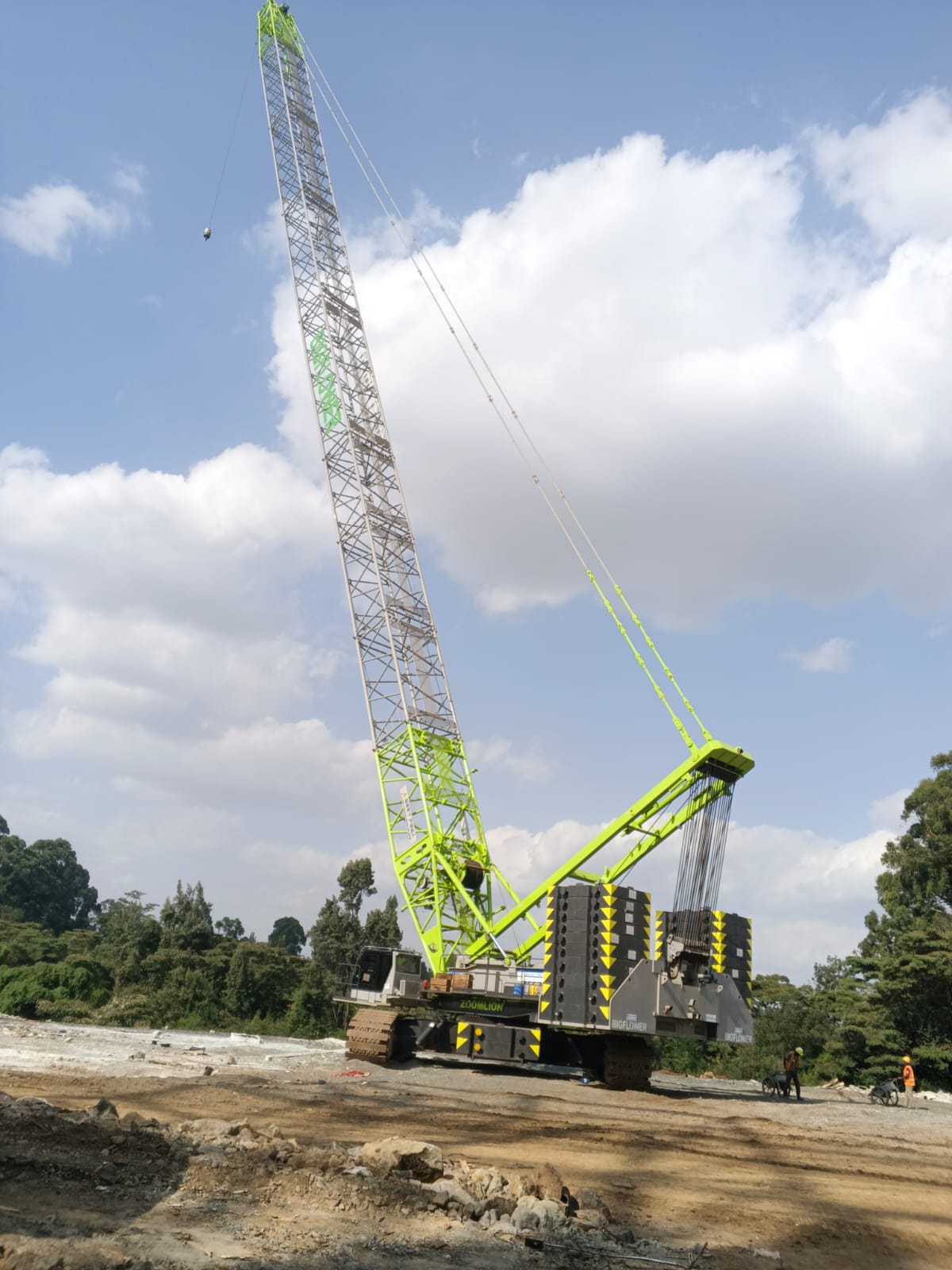
The trade-off is mobilisation: a crawler arrives on low loaders and is assembled on site.
Crawler Crane Hire: options, industries and applications
Where crawler cranes fit
- Heavy repetitive lifting
- Soft or uneven ground
- Lattice boom configurations
- No outriggers required
- Travel under load
- Long-duration site work
Industries we support
- Construction
- Infrastructure
- Energy
- Mining
- Marine works
Typical applications
- Piling support
- Bridge and civil works
- Heavy steel erection
- Plant installation
- Deep excavation support
Ground pressure is the whole argument
Because the load is spread along two tracks rather than concentrated under four outrigger pads, ground pressure is dramatically lower. On reclaimed ground, deep fill or a site that has been excavated and backfilled, that is often the deciding factor.
It is also why crawlers dominate piling and civil works, where the machine is standing on exactly the ground the project has just disturbed.
Where crawler crane hire fits
Crawler Crane Hire is not the right answer to every lifting problem, and it is worth being clear about where it fits before you book one.
The sectors that use it most here are construction, infrastructure, energy, mining and marine works. That is not a marketing list: those are the industries whose problems this machine was designed around, and it shows in how straightforward the jobs tend to be.
In practice the work divides into a handful of recurring tasks: piling support, bridge and civil works, heavy steel erection, plant installation, deep excavation support. If your job resembles one of those, this is almost certainly the right machine and the conversation will be short.
If it does not resemble any of them, that is worth saying when you call. It usually means either a different machine or a different approach entirely, and finding that out at the quoting stage costs nothing.
Mobilisation and assembly
A crawler does not drive to site. It arrives in sections on low loaders and is assembled with an assist crane, which means the delivery area, the assembly space and the access route all need checking first.
For that reason crawlers make sense on projects with weeks of lifting, not on a single afternoon's work. For that, hire a mobile crane.
Travelling with a load
A crawler can pick a load and track with it, within its duty chart. This removes the repeated set-up-and-strike cycle that slows a wheeled crane on a long site, and it is why crawlers suit linear works like pipelines and bridges.
Duty charts and configuration
A crawler's capacity depends on its boom configuration, the counterweight fitted and the position of the load relative to the tracks. Over the side is not the same as over the end, and the difference is substantial.
This matters at the planning stage because the configuration is decided before the machine is assembled. Changing it later means partial dismantling, which is a day's work rather than an adjustment. Getting the duty requirement right the first time is worth the effort.
Piling, civils and reclaimed ground
Crawlers dominate piling support because the machine is standing on exactly the ground the project has just disturbed. The same logic applies to deep excavation, bridge works and any site built on fill.
On reclaimed or made ground, the low bearing pressure of tracks is often the only thing that makes lifting possible at all without extensive ground improvement. Where a wheeled machine would need a piled platform, a crawler frequently does not.
What we need from you to quote
Quoting a crawler crane hire job accurately takes four things, and a photograph usually settles three of them at once. Send them on WhatsApp and you will normally have an answer the same day rather than after a site visit.
What the load is. Roughly what it weighs and what shape it is. A long or awkward item behaves differently from a compact one of the same mass.
Where the machine can stand. A photograph from the likely standing position. We are looking at surface, space, overhead obstructions and how the machine gets in.
How far it has to reach. The distance from the standing position to where the load lands is the number that decides the machine. A short lift close in and a long lift far out are different jobs even when the load is identical.
When you need it. Whether the window is fixed. A lift that must happen inside a shutdown or before a business opens is planned differently from one that can move by a day.
How the hire works
Hire runs by the day unless the job is short enough to price by the half day, and longer bookings are quoted at a weekly or monthly rate that works out considerably cheaper per day than repeat single bookings. If you are running a programme rather than a one-off lift, tell us the duration up front and we will price it that way.
The machine comes with its certified operator. Mobilisation to and from site is quoted separately and depends on distance and access, because a machine that drives itself costs a fraction of one that has to be transported.
We are open 24 hours, Monday to Sunday. Night and weekend work is priced as ordinary hire rather than as a premium emergency callout when it is booked in advance, which is why it pays to plan an out-of-hours lift rather than discover you need one.
Everything is confirmed in writing before the machine is dispatched: the machine, the operator, the window, the standing position and the price.
Safety, certification and what we will not do
Every machine leaves the yard load-tested and maintained on schedule, and every operator carries out a documented pre-use inspection before the first lift of the day. That inspection is not a formality: it is where a damaged sling, a hydraulic weep or a defective limit switch gets found while it is still cheap.
The operator works to the load chart for the configuration actually rigged, at the radius actually being worked. If the chart does not support the lift, the lift does not happen. That is a feature of what you are hiring rather than an obstruction, and it is worth saying plainly at the quoting stage rather than discovering it on the day.
Exclusion zones are maintained under the load throughout, and we will stop if people enter them. On sites where other trades are working through, that coordination is agreed before the first lift rather than negotiated during it.
Where a lift is complex, blind, over occupied space or involves two machines, we agree a lift plan and a signalling arrangement before anything moves, and we will ask for a banksman from your side or provide one from ours.
What goes wrong, and how to avoid it
Almost every job that goes badly does so for one of four reasons, and all four are avoidable at the enquiry stage rather than on the day.
The weight was estimated optimistically. A load described as roughly something turns out to be considerably more, and the machine that travelled cannot lift it. If you genuinely do not know, say so and we will size with margin rather than assume.
The standing position did not exist. The space that looked adequate on a plan is occupied, sloping, or over ground that will not take outrigger loads. A photograph taken from that spot resolves it before anyone travels.
Nobody checked overhead. Power lines, canopies, branches and neighbouring structures constrain the boom path far more often than people expect, and they are not visible in a plan view.
The site was not ready. The crane arrives and waits, because the fixing crew, the propping, the bearings or the access were not in place. Crane time spent waiting is the most expensive time on any site.
None of that is complicated. It is simply worth ten minutes before the booking rather than an hour of standing time afterwards.
Where we do this work in Nairobi
Crawler Crane Hire comes up constantly in Lavington, where townhouse and apartment scheme construction. We are on site just as often in Gigiri.
The same job looks different again in Muthaiga, where large tree removal and sectional dismantling. That is why we ask where the site is before we ask anything else.
We cover the whole of Nairobi. See every area we serve, or send us the location and we will confirm what the site needs.
We also serve these areas
- Crawler Crane Hire in Lavington
- Crawler Crane Hire in Gigiri
- Crawler Crane Hire in Muthaiga
- Crawler Crane Hire in Runda
- Crawler Crane Hire in Kitisuru and Loresho
- Crawler Crane Hire in Karen
- Crawler Crane Hire in Langata
- Crawler Crane Hire in Kibra
- Crawler Crane Hire in South B and South C
- Crawler Crane Hire in Nairobi Industrial Area
Frequently asked questions about crawler crane hire
When should I choose a crawler crane over a mobile crane?
On soft or uneven ground, for heavy repetitive lifting, and where the crane needs to move around the site under load.
Does a crawler crane need outriggers?
No. It works off its tracks, which is why its ground pressure is so much lower.
How does a crawler crane get to site?
In sections on low loaders, then assembled on site with an assist crane.
Is it worth it for a one-day lift?
Usually not. Mobilisation and assembly mean crawlers suit projects with sustained lifting.
Can it travel with the load suspended?
Yes, within the machine's duty chart and on a prepared route.
How is the machine delivered?
In sections on low loaders, then assembled on site with an assist crane. Delivery access and a laydown area both need checking first.
Can the configuration be changed once assembled?
Only by partial dismantling, which is a day's work. It is worth getting the duty requirement right before assembly.
Is a crawler better on reclaimed ground?
Usually decisively so. Track bearing pressure is a fraction of what outriggers impose, which often makes lifting possible without ground improvement.
Do crawlers work for piling support?
Yes, it is one of their main uses, because the machine stands on exactly the ground the works have just disturbed.
Is it worth it for a single day?
Rarely. Mobilisation and assembly mean crawlers suit sustained work.